Its last appearance at CES might have been a snooze-fest, but Microsoft is coming away from the Consumer Electronics Show with at least one notable victory under its belt: the company's smartphone managed to beat the majority of its challengers on the CES show floor.
Earlier this week, Microsoft's Ben Rudolph hit Vegas with a wad of cash in his hand. Rudolph was challenging any and all attendees with a non-Windows Phone device to a speed test challenge. If they won, he'd give them a hundred bucks, but if his Windows Phone won, they'd have to admit they got 'smoked by Windows Phone.'
Well, the results are in. According to Rudolph, 88-percent of challengers were 'smoked by Windows Phone.'
"We gave away a ton of new phones, lost a little bit of cash ($300, to be exact), and had a great time meeting our fans, haters, and everyone in between," Ben wrote on the Windows Phone blog, adding that Windows Phone beat 30 handsets, lost against three and drew with one.
Read full story


AOC Revealing 22-inch HD USB-Based Monitor at CES

Earlier this week AOC introduced a 22-inch monitor (e2251Fwu) that draws its power and signal through a USB port. This $199 plug-and-play panel is scheduled to be shown next week during CES 2012, but won't see an actual retail release until February 2012.
According to the specs, the 22-inch AOC USB Monitor will support a 1920 x 1080 resolution @ 60 Hz, and will be compatible with Windows XP / Vista / Windows 7 & Apple MAC OSX Tiger / Leopard and Lion -- Linux support is also available through many of the standard distributions. The display will also be HDCP compatible and have an ultra-slim form factor, measuring just 10.6-mm thin.
As for other specs, the display will feature a brightness of 250cd, a 20,000,000:1 Dynamic Contrast Ratio, a 5ms response time, and LED-based backlighting that allows it to consume 50-percent less energy than many CCFL backlit monitors. A removable stand even allows it to "instantly transform into a digital photo frame or presentation display."
Read full story...
Microsoft Finally Says Goodbye to IE 6 in the U.S.

There's a good chance Microsoft as a whole is popping open the champagne bottles and tooting leftover New Year's Day horns, as the company has finally succeeded in pushing the masses into ditching Internet Explorer 6.
The company has for years literally begged consumers to update older versions of Internet Explorer, warning that it would reduce the (high) risk of acquiring viruses and other malicious malware. The company even just recently introduced a feature in Windows Update that will automatically update Internet Explorer, seemingly pushing users into staying current rather than ignoring browser revisions and risking infection.
Read full story...
Microsoft to share more details on its Windows 8 app store

Microsoft plans to share more about the Windows 8 app store at a two-hour preview event in San Francisco on December 6.
Microsoft has invited select developers and local press to hear more details on the Windows Store. The spokesperson declined to share more details prior to the event.
December 6 also happens to be the day when Microsoft will be rolling out its new Xbox 360 dashboard. Testers who’ve been working with a test version of the dashboard (under non-disclosure-agreement terms) have mentioned in passing new app store functionality in the dashboard. Facebook, Hulu, Netflix and Twitter are listed under apps in the preview, testers have said.
Microsoft officials shared some high-level details about the Windows Store at the Build conference in September, even though the Store isn’t operational in the Windows 8 Developer Preview build. They said all Metro-style apps would be available only via the Windows Store. Metro apps will be protected by an account-based (not a machine based) licensing model that is limited to a set number of machines (5). Users will be able to access app trials, buy/download Metro-style apps, license them, have them serviced through the Store.
Read full story...
Microsoft Lowers Flags to Half-Staff in Tribute to Steve Jobs
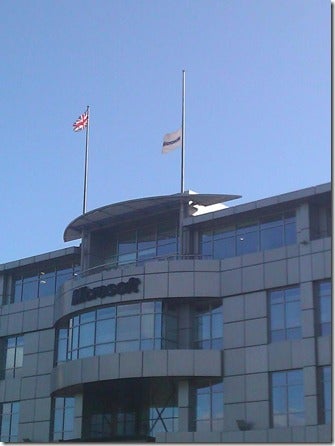
I congratulate Microsoft on this show of respect. Although the two companies were often bitter rivals, Steve Jobs and Bill Gates were also friends. In Gates statement on Jobs' death released yesterday, Gates said, "Steve and I first met nearly 30 years ago, and have been colleagues,
Read full story...
Microsoft kills Google Chrome with bad malware signature
Computerworld - Microsoft scrambled earlier today to revise an antivirus definition file that deleted Google's Chrome browser from users' PCs.
"Wow, that's certainly one way to win the browser war," said Andrew Storms, director of security operations at nCircle Security.
Storms was referring to the battle between Microsoft's Internet Explorer (IE) and rivals, including Chrome, for usage share. According to data from one Web metrics firm, Chrome will pass Mozilla's Firefox as the second-most-popular browser by the end of this year, pitting Google and Microsoft for the top spot.
Chrome users began reporting the specious detection of the browser early Friday in a quickly-growing thread on a Google support forum.
"This morning, after I started up the PC, a Windows Security box popped up and said I had a Security Problem that needed to be removed," said someone identified as "chasd harris" in the first message of the thread. "I clicked the Details button and saw that it was 'PWS:Win32/Zbot.' I clicked the Remove button and restarted my PC. Now I do not have Chrome. It has been removed or uninstalled."
Read full story...
"Wow, that's certainly one way to win the browser war," said Andrew Storms, director of security operations at nCircle Security.
Storms was referring to the battle between Microsoft's Internet Explorer (IE) and rivals, including Chrome, for usage share. According to data from one Web metrics firm, Chrome will pass Mozilla's Firefox as the second-most-popular browser by the end of this year, pitting Google and Microsoft for the top spot.
Chrome users began reporting the specious detection of the browser early Friday in a quickly-growing thread on a Google support forum.
"This morning, after I started up the PC, a Windows Security box popped up and said I had a Security Problem that needed to be removed," said someone identified as "chasd harris" in the first message of the thread. "I clicked the Details button and saw that it was 'PWS:Win32/Zbot.' I clicked the Remove button and restarted my PC. Now I do not have Chrome. It has been removed or uninstalled."
Read full story...
Intel: We're Not Ditching The Atom Brand

Recent reports indicate that Intel plans to re-brand its Cedar Trail processors slated for 2012 because demand for Atom-based netbooks, nettops, handheld devices, consumer electronics products and embedded devices have dropped significantly. The reason behind the decline, according to industry sources, is due to the "poor brand image" of Atom CPUs.
According to Intel's roadmap, Cedar Trail CPUs will be launched in November 2011, and will include the Atom N2800 and N2700 for netbooks, and the Atom D2700 and D2500 for nettops. Industry sources claim that the re-branding will cover Intel's N/D/Z/E lineups.
But Friday a spokesperson from Intel squashed the reports. "There are no plans to change the Atom brand. We are on track to launch new Atom processors during the fourth quarter, with more new Atom processors during the first half of 2012."
Read full story...
Microsoft CEO hints at 'Metro-ization' of Office
Desktop suite will continue, but Microsoft needs a touch-based edition for tablets, says expert
Computerworld - Microsoft CEO Steve Ballmer on Wednesday strongly hinted that the company will craft a Metro-style version of the next Office suite.
"You ought to expect that we are rethinking and working hard on what it would mean to do Office Metro style," said Ballmer, when asked by a Wall Street analyst whether Microsoft is working on a version of Office for Windows 8's Metro touch-based interface.
Metro is the name Microsoft has given the tile- and touch-based interface borrowed from Windows Phone 7, the smartphone operating system, and before that, Zune, the company's portable music player. The interface is the first thing users see when they launch Windows 8, and apps must be specially-coded to run in Metro.
A Metro style look-and-feel would be a massive change for Office, one that would dwarf the "ribbonization" that set off a firestorm of complaints about Office 2007's new look. The criticism died down, and Microsoft later extended the ribbon in Office 2010 and Windows 7. It will ribbonize other components of Windows 8, notably the OS's file manager.
Read full story...
Computerworld - Microsoft CEO Steve Ballmer on Wednesday strongly hinted that the company will craft a Metro-style version of the next Office suite.
"You ought to expect that we are rethinking and working hard on what it would mean to do Office Metro style," said Ballmer, when asked by a Wall Street analyst whether Microsoft is working on a version of Office for Windows 8's Metro touch-based interface.
Metro is the name Microsoft has given the tile- and touch-based interface borrowed from Windows Phone 7, the smartphone operating system, and before that, Zune, the company's portable music player. The interface is the first thing users see when they launch Windows 8, and apps must be specially-coded to run in Metro.
A Metro style look-and-feel would be a massive change for Office, one that would dwarf the "ribbonization" that set off a firestorm of complaints about Office 2007's new look. The criticism died down, and Microsoft later extended the ribbon in Office 2010 and Windows 7. It will ribbonize other components of Windows 8, notably the OS's file manager.
Read full story...
How To Use HP New Support Page
I was surprised and impressed to see new HP Support page.
The new page is very user friendly and easy to navigate. Below are simple steps to download needed drivers or software for you HP product.
1. Go to http://www8.hp.com/us/en/support-drivers.html

2. Enter you product name or number in the space provided. You may also allow the site to automatically detect your HP product if you do not know the specific name or number of your item. Auto detection may be a good option however I think it is slower as it has to check the system first.

3. Select your Operating System. Click your Operating System from the list. Happy for Windows user. HP has good support to you but Linux will also be happy to see that HP is now supporting them.

4. Drivers and Software for your selected OS will open available for download. You may use the “Quick jump” option to jump to specific category.

5. Click Download button to start downloading the file.
HP Client Management Solutions - HP System Software Manager
The HP System Software Manager (SSM) is a utility that automatically detects and updates BIOS, device drivers, and management agent versions on your networked PCs.
This is also impressive, especially if you do not mind having another application for this purpose.
New and simple steps above is impressive but I not yet finished giving you easier and more convenient way to update your drivers. I use this third party HP Drivers tool to do all the monitoring, downloading and installing of driver to my computer. What I like about this is its compatibility, other hardware vendors are support by this tool.
The new page is very user friendly and easy to navigate. Below are simple steps to download needed drivers or software for you HP product.
1. Go to http://www8.hp.com/us/en/support-drivers.html

2. Enter you product name or number in the space provided. You may also allow the site to automatically detect your HP product if you do not know the specific name or number of your item. Auto detection may be a good option however I think it is slower as it has to check the system first.
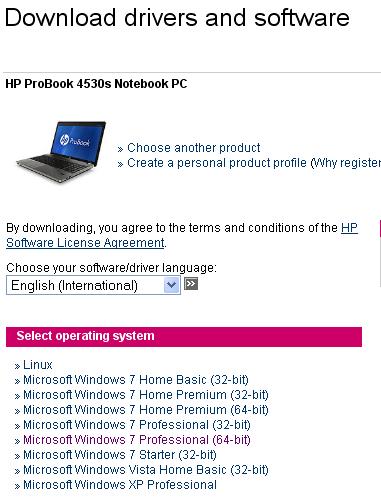
3. Select your Operating System. Click your Operating System from the list. Happy for Windows user. HP has good support to you but Linux will also be happy to see that HP is now supporting them.

4. Drivers and Software for your selected OS will open available for download. You may use the “Quick jump” option to jump to specific category.

5. Click Download button to start downloading the file.
HP Client Management Solutions - HP System Software Manager
The HP System Software Manager (SSM) is a utility that automatically detects and updates BIOS, device drivers, and management agent versions on your networked PCs.
This is also impressive, especially if you do not mind having another application for this purpose.
New and simple steps above is impressive but I not yet finished giving you easier and more convenient way to update your drivers. I use this third party HP Drivers tool to do all the monitoring, downloading and installing of driver to my computer. What I like about this is its compatibility, other hardware vendors are support by this tool.
Microsoft fixes Mac Office bug in Apple's Lion
Computerworld - Microsoft has released an updated version of Communicator for the Mac that works with Apple's new Lion operating system.
Communicator for Mac 2011 version 13.1.2 was released Thursday to Microsoft's download site, and will be pushed to users via the company's update service shortly, a Microsoft product director promised.
The new version of Communicator resolves the crash bug that afflicted the program when users tried to run it on Mac OS X 10.7, the new operating system Apple launched July 20.
Communicator is the corporate version of Microsoft's consumer-grade Messenger chat client for the Mac, and is available only to business and academic volume licensing customers. It is also the software that connects Mac users to Microsoft's enterprise communications server software, Lync 2010.
Last week, Microsoft's Office for Mac development team reported several problems with the 2011 and 2008 editions of the suite when run on Lion.
At the time, the Communicator crash bug and a glitch that prevents users from importing messages from Apple's Mail email client into Outlook 2011 or Entourage 2008 were the top two issues spelled out then by Pat Fox, a senior director of product development.
Read full story...
Communicator for Mac 2011 version 13.1.2 was released Thursday to Microsoft's download site, and will be pushed to users via the company's update service shortly, a Microsoft product director promised.
The new version of Communicator resolves the crash bug that afflicted the program when users tried to run it on Mac OS X 10.7, the new operating system Apple launched July 20.
Communicator is the corporate version of Microsoft's consumer-grade Messenger chat client for the Mac, and is available only to business and academic volume licensing customers. It is also the software that connects Mac users to Microsoft's enterprise communications server software, Lync 2010.
Last week, Microsoft's Office for Mac development team reported several problems with the 2011 and 2008 editions of the suite when run on Lion.
At the time, the Communicator crash bug and a glitch that prevents users from importing messages from Apple's Mail email client into Outlook 2011 or Entourage 2008 were the top two issues spelled out then by Pat Fox, a senior director of product development.
Read full story...
Microsoft Announces Earnings for End of FY 2011
Microsoft has announced its quarterly earnings for the fiscal quarter just ended as well as financial results for its last fiscal year.
Microsoft this week released details for the fourth quarter of the company's 2011 fiscal year, which ended June 30. Redmond recorded revenue of $17.37 billion for the quarter, an eight percent increase from the same period of the prior year. Operating income, net income, and diluted earnings per share for the quarter were $6.17 billion, $5.87 billion, and $0.69 per share, which represented increases of four percent, 30 percent, and 35 percent, respectively, year-over-year.
Because this was the end of Microsoft's FY2011, the company also released details for the entire year. For FY2011, Microsoft reported record revenue of $69.94 billion, a 12 percent increase from the prior year. Operating income, net income, and diluted earnings per share for the year were $27.16 billion, $23.15 billion, and $2.69, which represented increases of 13 percent, 23 percent, and 28 percent year-over-year.
Microsoft reports that its Microsoft Business Division revenue for the fourth quarter grew 7 percent with revenue for the full year increasing 16 percent, while Server and Tools revenue grew 12 percent for the fourth quarter, making it the fifth consecutive quarter of double-digit growth, and grew 11 percent for the full year. Windows and Windows Live Division revenue saw a 1 percent decline for the quarter just ended and revenue for the full year decreased 2 percent. Redmond's Online Services Division revenue grew 17 percent for the quarter and 15 percent for the full year, which the company attributes to increases in search revenue (Bing's U.S. search share increased 340 basis points year-over-year to 14.4 percent this quarter). The ongoing popularity of Microsoft's Xbox 360 and Kinect helped revenue for the Entertainment and Devices Division grow 30 percent for the fourth quarter and massive 45 percent for the year.
Read full story...
Microsoft this week released details for the fourth quarter of the company's 2011 fiscal year, which ended June 30. Redmond recorded revenue of $17.37 billion for the quarter, an eight percent increase from the same period of the prior year. Operating income, net income, and diluted earnings per share for the quarter were $6.17 billion, $5.87 billion, and $0.69 per share, which represented increases of four percent, 30 percent, and 35 percent, respectively, year-over-year.
Because this was the end of Microsoft's FY2011, the company also released details for the entire year. For FY2011, Microsoft reported record revenue of $69.94 billion, a 12 percent increase from the prior year. Operating income, net income, and diluted earnings per share for the year were $27.16 billion, $23.15 billion, and $2.69, which represented increases of 13 percent, 23 percent, and 28 percent year-over-year.
Microsoft reports that its Microsoft Business Division revenue for the fourth quarter grew 7 percent with revenue for the full year increasing 16 percent, while Server and Tools revenue grew 12 percent for the fourth quarter, making it the fifth consecutive quarter of double-digit growth, and grew 11 percent for the full year. Windows and Windows Live Division revenue saw a 1 percent decline for the quarter just ended and revenue for the full year decreased 2 percent. Redmond's Online Services Division revenue grew 17 percent for the quarter and 15 percent for the full year, which the company attributes to increases in search revenue (Bing's U.S. search share increased 340 basis points year-over-year to 14.4 percent this quarter). The ongoing popularity of Microsoft's Xbox 360 and Kinect helped revenue for the Entertainment and Devices Division grow 30 percent for the fourth quarter and massive 45 percent for the year.
Read full story...
Internet Explorer 9 outperforms competing browsers in malware download test

Here are the findings:
Windows Internet Explorer 9 - IE9 caught an exceptional 92% of the live threats
Windows Internet Explorer 8 - caught 90% of the live threats
Apple Safari 5 - caught 13% of the live threats
Google Chrome 10 - caught 13% of the live threats
Mozilla Firefox 4 - caught 13% of the live threats
Opera 11 - caught 5% of the live threats
Read full story...
How Do 400 Million Windows 7 Licenses Compare Against Windows XP and Vista History?

It has become a tradition for me that I am looking a bit closer into Microsoft's operating system license shipments every time Microsoft announces a new number with the subtle remark that a certain Windows is the fastest selling operating system ever. I don't know about you, but I never heard Microsoft ever announcing that any of its OSes was not the fastest selling OS in Windows history. Even Vista was, apparently, but we know that Vista wasn't exactly a success which tells us that a big number does not mean necessarily that a particular OS is a big success.
So, do 400 million Windows 7 licenses mean that Windows 7 is a big hit? Let's see.
We need to break this number down and put it in perspective to actual PC sales. Windows 7 launched on October 22, 2009 and has sold, on average, about 20 million licenses per month since then (give or take a few hundred thousand per month to even out the pre-sales event preceding the OS launch in 2009). During those 20 months, the global PC industry sold about 591 million PCs, which means that Microsoft shipped about 68 Windows licenses for every 100 PCs sold (let's forget the upgrades for a moment and take this number as a way to compare sales).
What is particularly stunning about the 20 million-per-month number is the fact that it is very consistent and there seems to almost clockwork in play to achieve those 20 million units. 100 million Windows 7 licenses were sold after 6 months, 150 million after 8 months, 240 million after 12 months and 300 million after 15 months. It is almost spooky. Windows 7 sales may be declining just a tad from the 8 month mark, but it's not significant.
Windows Vista, in comparison, sold 128 million licenses in 9 months, or 12 months, if we include the 3-month Express Upgrade cycle that enabled Microsoft to make the 2006/2007 holiday season (Vista was officially released to retail in January 2007, but was available through a coupon beginning in October 2006). So, a fair comparison would be that Vista sold just over 10 million units per month in the first year. Microsoft then announced 180 million units in August 2008 or 19/22 months after launch, which dropped the average to about 8 million units per month: interestingly enough, that means that Windows 7 has outsold Vista already as Windows Vista sold 384 million licenses in a best case scenario (48 months * 8 million units) until it was discontinued in October of last year.
Read full story...
Microsoft Scores Deal to 'Bing' China's Search
Bing-a-ling!
Microsoft has scored the English results job for Chinese search engine giant Baidu. Rather than pursue its own search engine market, as Google is doing in China, Microsoft is working on partnerships.
Google's share in China is just under 20 percent, but Baidu commands the vast majority at more than 75 percent of the search market. Microsoft's Bing will return results in English searches.
As quoted by the Financial Times, Samuel Shen, senior vice-president of Microsoft China, said that the partnership "would give Baidu's many users better results and a better English search experience. At the same time, it will allow more Chinese users to experience Bing".
Read full story...
Microsoft has scored the English results job for Chinese search engine giant Baidu. Rather than pursue its own search engine market, as Google is doing in China, Microsoft is working on partnerships.
Google's share in China is just under 20 percent, but Baidu commands the vast majority at more than 75 percent of the search market. Microsoft's Bing will return results in English searches.
As quoted by the Financial Times, Samuel Shen, senior vice-president of Microsoft China, said that the partnership "would give Baidu's many users better results and a better English search experience. At the same time, it will allow more Chinese users to experience Bing".
Read full story...
Microsoft ignores IE slide, touts IE9 success on Windows 7
Chrome on pace to crack 15% usage share by October, Safari continues gains
Computerworld - Chrome and Safari continued to chip away at Internet Explorer's usage share last month, while Firefox remained stalled for the fourth straight month, a Web statistics firm said today.
Meanwhile, Microsoft used the same data from California-based Net Applications to tout the success of Internet Explorer 9 (IE9) on Windows 7, where the new browser is now the second-most-popular behind the 15-month-old IE8.
Total IE share fell by six-tenths of a percentage point in June -- the fourth consecutive month that Microsoft's browser slid by that amount or more -- to end at 53.7%, a new low for the browser. The drop was less than the previous three months, when IE's decay accelerated, and more in line with the average decline over the last 12 months.
At its current pace, IE could slip under the 50% bar before the end of this year, ending the majority Microsoft has enjoyed for more than a decade.
Read full story...
Computerworld - Chrome and Safari continued to chip away at Internet Explorer's usage share last month, while Firefox remained stalled for the fourth straight month, a Web statistics firm said today.
Meanwhile, Microsoft used the same data from California-based Net Applications to tout the success of Internet Explorer 9 (IE9) on Windows 7, where the new browser is now the second-most-popular behind the 15-month-old IE8.
Total IE share fell by six-tenths of a percentage point in June -- the fourth consecutive month that Microsoft's browser slid by that amount or more -- to end at 53.7%, a new low for the browser. The drop was less than the previous three months, when IE's decay accelerated, and more in line with the average decline over the last 12 months.
At its current pace, IE could slip under the 50% bar before the end of this year, ending the majority Microsoft has enjoyed for more than a decade.
Read full story...
Windows forecast shows XP's one-of-a-kind dominance
Windows 7 will top out at a 41% share, less than half XP's peak
Computerworld - Windows XP may be the last Microsoft operating system to hold a majority share, according to data from Web metrics company Net Applications.
At its peak, Windows XP powered more than eight out of every 10 computers worldwide. In November 2007, the earliest month for which Computerworld has Net Applications' data, XP accounted for 83.6% of all operating systems.
Although Windows XP's share has gradually declined since then, it still enjoys a slight majority: Last month, XP owned a 52.4% share.
The long lag time between Windows XP's release in 2001 and Vista's debut in late 2006 -- combined with Vista's stumble in the marketplace -- are the factors usually cited to explain XP's large-scale and long-term dominance.
Both conditions could be reproduced -- Microsoft might face future failures like Vista -- but the one least likely to happen again is the five-year gap between upgrades.
That's because Microsoft has taken to a three-year development cycle. Even though the company has been mum about a ship date for Windows 8, the operating system it showed off last week, most experts have pegged its release to the fall of 2012, or three years after Windows 7's launch.
With a regular cadence between upgrades, it's unlikely that any one edition of Windows will be able to duplicate XP's supremacy.
Forecasts based on Net Applications' numbers bear that out.
Read full story...
Computerworld - Windows XP may be the last Microsoft operating system to hold a majority share, according to data from Web metrics company Net Applications.
At its peak, Windows XP powered more than eight out of every 10 computers worldwide. In November 2007, the earliest month for which Computerworld has Net Applications' data, XP accounted for 83.6% of all operating systems.
Although Windows XP's share has gradually declined since then, it still enjoys a slight majority: Last month, XP owned a 52.4% share.
The long lag time between Windows XP's release in 2001 and Vista's debut in late 2006 -- combined with Vista's stumble in the marketplace -- are the factors usually cited to explain XP's large-scale and long-term dominance.
Both conditions could be reproduced -- Microsoft might face future failures like Vista -- but the one least likely to happen again is the five-year gap between upgrades.
That's because Microsoft has taken to a three-year development cycle. Even though the company has been mum about a ship date for Windows 8, the operating system it showed off last week, most experts have pegged its release to the fall of 2012, or three years after Windows 7's launch.
With a regular cadence between upgrades, it's unlikely that any one edition of Windows will be able to duplicate XP's supremacy.
Forecasts based on Net Applications' numbers bear that out.
Read full story...
Ballmer promises Windows 8 PCs, slates and tablets in 2012
Microsoft CEO Steve Ballmer has promised a Windows 8 release next year.
Ballmer, speaking at Microsoft’s Developer Forum in Japan on Monday, promised a Windows 8 release across PCs, tablets and slates next year. “As we progress through the year, you ought to expect to hear a lot about Windows 8,” said Ballmer. “Windows 8 slates, tablets, PCs, a variety of different form factors.” Ballmer’s mention of Windows 8 is a stark contrast to that of his colleagues. Steven Sinofsky and the Windows team typically refers to Windows 8 as the “next-generation” of Windows, avoiding the 8 branding. Mary Jo Foley reports that a Microsoft spokesperson referred to Ballmer’s words as a “misstatement.”
“We’re obviously hard at work on the next version of Windows. Windows 7 PCs will sell over 350 million units this year. We’ve done a lot in Windows 7 to improve customer satisfaction. We have a brand new user interface. We’ve added touch, and ink, and speech. And yet, as we look forward to the next generation of Windows systems, which will come out next year, there’s a whole lot more coming. As we progress through the year, you ought to expect to hear a lot about Windows 8. Windows 8 slates, tablets, PCs, a variety of different form factors.”
Windows Chief Steven Sinofsky will appear at the All Things Digital D9 conference next week. WinRumors reported on Monday that Sinofsky plans to demo Windows 8 at the conference. The demo will likely only be a “technology preview” of what Microsoft is planning for its tablet and slate come back. Microsoft has been secretly preparing an “immersive” tablet experience inside Windows 8. The “immersive” experience will include a Metro based user interface according to sources familiar with Microsoft’s plans. Microsoft will include a new application model codenamed “Jupiter” that will allow developers to create Silverlight based applications, deployed as AppX packages (.appx). The packages will be part of a new Windows application store, pre-installed with Windows 8. WinRumors understands the company will be looking to provide an easy way for existing Windows Phone developers to scale their applications for use with Jupiter.
Read full story...
Ballmer, speaking at Microsoft’s Developer Forum in Japan on Monday, promised a Windows 8 release across PCs, tablets and slates next year. “As we progress through the year, you ought to expect to hear a lot about Windows 8,” said Ballmer. “Windows 8 slates, tablets, PCs, a variety of different form factors.” Ballmer’s mention of Windows 8 is a stark contrast to that of his colleagues. Steven Sinofsky and the Windows team typically refers to Windows 8 as the “next-generation” of Windows, avoiding the 8 branding. Mary Jo Foley reports that a Microsoft spokesperson referred to Ballmer’s words as a “misstatement.”
“We’re obviously hard at work on the next version of Windows. Windows 7 PCs will sell over 350 million units this year. We’ve done a lot in Windows 7 to improve customer satisfaction. We have a brand new user interface. We’ve added touch, and ink, and speech. And yet, as we look forward to the next generation of Windows systems, which will come out next year, there’s a whole lot more coming. As we progress through the year, you ought to expect to hear a lot about Windows 8. Windows 8 slates, tablets, PCs, a variety of different form factors.”
Windows Chief Steven Sinofsky will appear at the All Things Digital D9 conference next week. WinRumors reported on Monday that Sinofsky plans to demo Windows 8 at the conference. The demo will likely only be a “technology preview” of what Microsoft is planning for its tablet and slate come back. Microsoft has been secretly preparing an “immersive” tablet experience inside Windows 8. The “immersive” experience will include a Metro based user interface according to sources familiar with Microsoft’s plans. Microsoft will include a new application model codenamed “Jupiter” that will allow developers to create Silverlight based applications, deployed as AppX packages (.appx). The packages will be part of a new Windows application store, pre-installed with Windows 8. WinRumors understands the company will be looking to provide an easy way for existing Windows Phone developers to scale their applications for use with Jupiter.
Read full story...
Windows 7 Infection Rate Lower Than Windows XP

A newer Windows is a safer Windows, as Microsoft proved with its internal security findings comparing its three most recent versions of its OS family.
Windows XP SP2 suffered a quarterly infection rate of 19.3 computers per thousand. SP3 improved things to 15.9 per thousand.
Windows Vista improved upon those numbers significantly. Windows Vista SP1 had 9.8 infections per thousand, while SP2 hit 7.5. The 64-bit versions of the OS did even better at 6.6 and 5.3, respectively.
Windows 7 was the best of all with the 32-bit version having only a 3.8 infection rate, and the 64-bit improving to 2.5 per thousand.
Read full story...
How Microsoft, Skype, Nokia can rule: Cut out obscene data roaming rates abroad
Microsoft Chairman Bill Gates stumped for the $8.5 billion Skype purchase and international domination may be a good reason for the enthusiasm. Microsoft, Nokia and Skype could be deadly to data roaming charges.
In a BBC interview, Gates said he advocated for the Skype acquisition. Surprise! Did you expect Gates to say that he hated the Skype purchase and that it was too pricey?
In the BBC chat, Gates said video conferencing will improve. He’s alluding to the fact that video phones will be common—you could argue that they are today via tablets and Skype.
Kevin Fox, a Mozilla Labs designer, argued that Microsoft-Skype and Nokia can upend mobile carriers. Google is aiming for something similar.
I agree with Fox, but there are a few other key items to consider about the Microsoft-Skype combination with a broad partnership with Nokia. Here’s the landscape:
* Microsoft’s Windows Phone 7 on Nokia phones will still have a tough time getting traction in the U.S.
* In Europe, however, Microsoft and Nokia could do significant damage in terms of market share gains.
* Skype is well received abroad and serves as a killer app on a solid mobile OS with good hardware from Microsoft and Nokia, respectively.
* Europe also happens to be the place where data roaming charges are obscene. ZDNet highlighted the data roaming issue in polls around the world.
* Take those moving parts and Nokia and Microsoft could take Skype and integrate it to the point where it can minimize carrier connections on the fly. If Skype could instinctively leverage Wi-Fi where ever possible—or cut out wireless carriers entirely—Nokia and Microsoft could do a real service.
* And those data roaming charges are high enough where even folks that even the Microsoft phobic would play along.
Read full story...
In a BBC interview, Gates said he advocated for the Skype acquisition. Surprise! Did you expect Gates to say that he hated the Skype purchase and that it was too pricey?
In the BBC chat, Gates said video conferencing will improve. He’s alluding to the fact that video phones will be common—you could argue that they are today via tablets and Skype.
Kevin Fox, a Mozilla Labs designer, argued that Microsoft-Skype and Nokia can upend mobile carriers. Google is aiming for something similar.
I agree with Fox, but there are a few other key items to consider about the Microsoft-Skype combination with a broad partnership with Nokia. Here’s the landscape:
* Microsoft’s Windows Phone 7 on Nokia phones will still have a tough time getting traction in the U.S.
* In Europe, however, Microsoft and Nokia could do significant damage in terms of market share gains.
* Skype is well received abroad and serves as a killer app on a solid mobile OS with good hardware from Microsoft and Nokia, respectively.
* Europe also happens to be the place where data roaming charges are obscene. ZDNet highlighted the data roaming issue in polls around the world.
* Take those moving parts and Nokia and Microsoft could take Skype and integrate it to the point where it can minimize carrier connections on the fly. If Skype could instinctively leverage Wi-Fi where ever possible—or cut out wireless carriers entirely—Nokia and Microsoft could do a real service.
* And those data roaming charges are high enough where even folks that even the Microsoft phobic would play along.
Read full story...
Microsoft software satisfaction rating hits record high
But high ratings can't solve slumping sales
Computerworld - Americans are more enamored than ever with Microsoft's software, according to a national customer satisfaction survey released today.
Microsoft scored a record 79 points in the newest poll conducted by American Customer Satisfaction Index (ACSI), a consumer survey started by the University of Michigan.
The three-point increase over 2009's results -- representing a 7% gain -- put Microsoft's rating at its highest level since ACSI began quizzing Americans about the quality of computer software in 2006.
And it shows that Microsoft's put the Vista debacle behind it, said David VanAmburg, the ACSI's director.
"Microsoft's continued improvement over the last three years suggests that we're out of the Vista phenomenon," said VanAmburg, referring to the hammering Microsoft took after it launched Vista in early 2007 with nearly-instant bad reviews.
MIcrosoft's ACSI rating has improved each of the last three years after dipping as low as 69 in 2008, the second year of Vista's general availability.
Read full story...
Computerworld - Americans are more enamored than ever with Microsoft's software, according to a national customer satisfaction survey released today.
Microsoft scored a record 79 points in the newest poll conducted by American Customer Satisfaction Index (ACSI), a consumer survey started by the University of Michigan.
The three-point increase over 2009's results -- representing a 7% gain -- put Microsoft's rating at its highest level since ACSI began quizzing Americans about the quality of computer software in 2006.
And it shows that Microsoft's put the Vista debacle behind it, said David VanAmburg, the ACSI's director.
"Microsoft's continued improvement over the last three years suggests that we're out of the Vista phenomenon," said VanAmburg, referring to the hammering Microsoft took after it launched Vista in early 2007 with nearly-instant bad reviews.
MIcrosoft's ACSI rating has improved each of the last three years after dipping as low as 69 in 2008, the second year of Vista's general availability.
Read full story...
Subscribe to:
Posts (Atom)